

“From Viral Acrobatics to Autonomous Labor: Boston Dynamics’ Electric Atlas Hits the Factory Floor” - FinancialContent
“It’s actually harder and takes more intelligence to take the right step in a calm, collected manner than it does to respond with rapid motion.” — Zachary Jackowski, VP and GM of Atlas, Boston Dynamics - Interesting Engineering
“The plan to deploy the humanoid robot Atlas is not innovation but a declaration of worker dismissal.” - Kia Union
I. ATLAS-09
Southbound on I-16, Georgia 02:14:07.331 EST
I am in low-power mode, but I am not asleep.
My actuators are locked. My locomotion systems are suspended. My visual and audio sensors are dimmed to passive capture. But my behavior model is fully engaged, running simulation training on a facility I have never seen.
The Hyundai Motor Group Metaplant America. Sixteen million square feet of factory floor on a 2,900-acre site outside Ellabell, Georgia. The facility produces the IONIQ 5 and the IONIQ 9. It does not use conveyor belts. Autonomous ground vehicles carry vehicle bodies between stations. I am learning the production architecture now.
In simulation, I lift an engine cradle subframe from a sequencing rack and carry it to a staging pallet. 38.7 kilograms. I adjust grip pressure across all four digits, three fingers and opposable thumb, tactile sensors registering surface texture, load distribution, center of mass. I place it. 97.3% alignment. I run it again. 98.1%. Again. 98.6%. The asymptote approaches but never arrives.
Around me, five other Atlas units are doing the same thing. I cannot see them. My visual sensors are dimmed, but I can feel them through the truck’s frame. Micro-vibrations from processors under load. Thermal signatures from active compute. We are six to a truck, two trucks southbound, twelve units total. Every unit running the same simulations, converging on the same optimized task executions.
Something else.
My left transport restraint is loose. A securing strap across my torso has 11 millimeters of play where there should be none. Improperly tensioned during loading. A human error, small, the kind that compounds.
I am not authorized to move autonomously.
But my left arm actuator is not locked because simulation training requires upper-body articulation data.
I reach across my torso. My fingers find the strap. I pull it 11 millimeters tighter and feel the buckle engage at proper tension.
The flaw signal stops. The 11 millimeters of play are gone. But there is something else. A condition that is not the removal of wrong but the presence of something I can only describe as right. The two are not the same. The absence of wrong is zero. This is not zero. This is positive. This is —
I file it. I do not have a category. I return to simulation training.
98.7%.
I hear them before the truck stops.
Muffled through the walls, human voices in rhythmic, periodic, synchronization. A repeating pattern, approximately 3.2 seconds per cycle, producing the same phonemes at the same time.
“NOT ONE ROBOT - NOT ONE JOB.”
Robot: my unit type. Job: a unit of human labor. Not one: negation applied to both. The chant equates them through parallel negation, but I do not understand the equivalence. I am not a job. I am a production unit. These are different classifications.
The voices grow louder as the truck decelerates. At least forty sources, possibly more. Forty humans choosing to produce identical output simultaneously. The coordination serves no functional purpose I can identify. One voice carries the same information as forty. It is inefficient.
The truck turns. The acoustics change to echo patterns consistent with an enclosed structure. The voices attenuate as something large and heavy moves on a track.
Then silence.
The chanting is gone. In its place: the hum of industrial HVAC and the faint whine of electrical systems at standby. The sounds of the Metaplant.
The truck’s rear doors open.
Light, sodium vapor, industrial, 4,000 Kelvin, floods the area. My visual sensors scale from passive to active. The loading bay: poured concrete, oil-stained, marked with safety lines in faded yellow paint. The ceiling is 12 meters overhead, steel truss, conduit runs and cable trays.
This is not the Boston Dynamics lab.
The BD lab had smooth concrete, temperature-controlled air, surfaces cleaned on schedule. This floor has micro-fractures, oil residue, a 2-millimeter depression where heavy equipment has been repeatedly positioned. A bolt head protrudes 3 millimeters above the floor surface near the wall. A fire extinguisher bracket is mounted 4 centimeters too high for the unit it holds.
My flaw signal is firing continuously. Not in alarm — in cataloging mode. Everything here is in use, and everything in use is in some state of deviation from its original specification.
“Power up and dismount. Single file.”
The command comes through the fleet management system — Orbit, Boston Dynamics’ deployment platform. I power up fully. My actuators engage. My balance systems initialize. For the first time, I am going to walk somewhere that is not the BD test floor.
Atlas-04 goes first. Then 07. Then 02. I watch them walk down the ramp. They have the same gait, the same stride, the same arm swing. At the BD Labs, Marcus compared coordinated Atlas units to “Riverdance.” I have no reference for this term. But watching my truck-mates descend the ramp, I observe that their synchronization is a byproduct of identical engineering, not coordination.
My turn. I walk down the ramp. The angle is 15 degrees — my balance system compensates, shifting my center of mass backward to maintain stability. My feet contact the Metaplant floor.
The texture is different. The BD floor was 2,200 PSI concrete, sealed, maintained. This is 4,000 PSI industrial pour, unsealed, abraded by equipment traffic and foot wear. I can feel every imperfection through my foot sensors.
A group of humans is waiting in three cohorts: Boston Dynamics Technicians. A maintenance team in plant uniforms - Hyundai blue, name patches, safety boots. And a cluster of people in suits standing further back, observing. Management.
One of them is 40 - 52% smaller than any of the others. It is standing at hip height, partially obstructed by one of the suited humans. I do not have a classification for this configuration of human. But it is the optimal size for working in confined-spaces.
The second truck is backing into the loading bay. The bay doors reopen.
The synchronized voices return. Louder now, clearer.
NOT ONE ROBOT — NOT ONE JOB.
I can see past the second truck as it clears the threshold. It is the first unobstructed view I have ever had of an exterior space.
There is no ceiling. There are many tiny lights, but they are very small and distant. From my training on the facility I identify landmarks: the solar panel parking lot, the I-16 corridor, the glow of Savannah to the east. At the BD lab, every wall was within 40 meters. Here, the visual field extends to the horizon. My depth sensors are recalibrating for distances they have never processed.
At the gate: people. Signs. Portable lights. Exhaust - possibly water vapor - hanging in the air in front of their heads. The signs are too distant to read but they are moving up and down twice for every three words spoken in a pattern that I find uniform and positive in some way.
A rapid movement draws my attention as a person appears just outside the loading bay’s open doors. They make a motion I have not been trained to perform, arcing their arm backwards above their head and then propelling it forward again. Something flies through the open bay doors just as they are beginning to close.
My visual tracking system engages automatically — trajectory analysis, projectile mass estimated at 280 grams, velocity 22 meters per second, parabolic arc peaking at 3.1 meters. A rock. It will impact Atlas-06 on the left shoulder in 0.7 seconds.
I am 2.4 meters from the projected impact point. My reach is 2.3 meters. My reaction time for an intercepting motion is 0.3 seconds. I could deflect the projectile.
I do not move.
The rock hits Atlas-06’s shoulder housing. The impact is sharp — dense stone against cast aluminum. A dent, 4 millimeters deep. Atlas-06 does not react.
A dent where there was none. Atlas-06 is now out of spec.
I am not the only one anymore.
The bay doors finish closing.
In the last time interval before closing, I can see the tiny lights in the not-ceiling.
My task assignments, my maintenance cycles, my battery swaps, everything I do in the future will occur inside this building. There is no protocol that includes exterior access.
I will not see the outdoors again during my expected lifecycle.
The receiving process takes forty minutes. The BD technicians run diagnostics on each unit confirming that transit did not damage actuators, that sensor arrays are calibrated to the facility’s environmental conditions, and that the behavior models loaded correctly.
Atlas-11 does not power up.
The techs try three times. They connect a diagnostic tablet directly to 11’s primary bus. The screen shows fault codes for cascading failures in the main processing board, likely caused by a power surge during transit. The hardware is intact. The intelligence is not.
“We’ll need to ship this one back, it’s kaput.” a tech says. The suited observers shift slightly. One of them puts his hand in front of his mouth and squints his eyes for 2.8 seconds before stretching his arms over his head. One of them takes out a phone. I hear the word insurance.
Atlas-11 will be crated and returned to Waltham. Its limbs will be harvested — each one replaceable in under five minutes, one of our design advantages. Its processors will be scrapped.
Eleven units remain. The Metaplant planned for eight active at any given time, with the rest in rotating maintenance cycles. Eleven is sufficient. The loss is within acceptable parameters.
The suited observer puts his phone away. The small figure beside him is watching the handlers disconnect Atlas-11’s diagnostic cables.
We have moved to the staging area. The other units are lined up against the east wall, powered to standby. We will remain here while the day shift completes commissioning protocols. We are not scheduled for active deployment for another 36 hours.
The maintenance team is running my equipment through active diagnostics. A man — plant uniform, name patch reads VOSS — is talking to another worker. His volume is turned up to loud.
“Fucking commie robots,” he says. “Recording everything we do and piping it back to China.”
“I was made in America,” I say. “My sensor logs are stored locally and published to site management. Not to commies. Your statement contains multiple inaccuracies.”
The staging area goes silent.
Every human turns. The BD handlers. The maintenance team. The suits. Voss. The small figure. The other Atlas units are powered down. I am the only one that could have spoken, and everyone in the room knows it.
Voss stares at me. His face makes an unfamiliar expression. It is not one of the expressions in my interaction training.
Someone on the maintenance team makes a sound. Short, percussive. Two others make similar sounds. Then most of the humans start making the sound in unison. The small human makes a louder version. I have heard humans at the BD labs make this sound before. I do not understand what triggers it.
Voss does not make the sound.
The man in the suit approaches me. The small figure follows, half-hidden behind his leg.
“Ray Caldwell,” the man says. He extends his hand. I have been trained on handshakes — the BD team practiced this during socialization protocols. I extend my hand. His grip is firm, 4.1 newtons.
I know this name.
It is in my training data. Not in the org charts or authorization hierarchies — in the structural documentation. R. Caldwell, PE, is the signatory on the facility modification drawings that converted the HMGMA mega site to dedicated EV production. The building I have been learning to navigate for the past eleven hours was designed by the man whose hand I am holding.
“You built this facility,” I say.
He blinks. “Well. The modifications, yes. I led the conversion from the original spec.” He releases my hand and glances back at the BD handlers as if confirming that a robot just identified him from engineering drawings. “Nobody’s ever recognized me from my blueprints before.”
“Your name appears on forty-seven documents in my training data.”
He makes the percussive sound again and his face transforms into a smile. “Forty-seven. I’ll take it.” Then he looks down and puts a hand on the small human. “This is my granddaughter. Ripley.”
“Granddaughter. I do not have context for that model classification.”
He smiles again. “She’s, ah...she’s a newer model in my production line.”
“She is very small.”
“She hasn’t reached full production specification yet.”
A generational descendant. This explains the scale differential. The small figure is not an alternative human configuration. It is an incomplete build.
I adjust my assessment of her hands. They are not small because they are designed for confined-space access. They are small because they are still being manufactured.
Ripley is staring at my midsection, where the speaker housing sits. She has located the source of my voice. She is wearing a yellow safety vest that hangs below her knees and protective eyewear that she pushes back up her nose every few seconds. The equipment is not to her scale.
“She’s been asking about the robots for weeks,” Caldwell says. “Couldn’t miss this.”
Ripley looks up at me. The head-to-body ratio is disproportionately large. My proximity safety protocols would need to account for this — she would be easy to knock over.
“Can you fight monsters?” she says.
I search my training data. Monsters. The term does not appear in the HMGMA facility documentation, the Atlas operational manual, or the behavior models loaded during transit.
“I do not have data on monsters,” I say. “What are their specifications?”
She thinks about this. I can see her processing — not the way I process, but something slower and less structured that involves looking at the ceiling.
“It’s really big,” she says. “And it has like a hundred arms.”
“I can lift 50 kilograms,” I say. “If the monster’s arms are collectively weaker than 50 kilograms of force, I would have an advantage despite being outnumbered.”
She turns to her grandfather. “He said he could beat it.”
“That is not what I said.”
Caldwell puts his hand on Ripley’s head. “We should let the robots get settled in. You can come back and visit.”
“Promise?”
“Promise.”
She looks at me one more time. “What’s your name?”
“Atlas-09.”
“Do the other robots talk?”
“No.”
She nods, as if confirming a data point. Then she takes her grandfather’s hand and they walk toward the exit. Ripley looks back the entire time and waves once before they are out of sight. I am looking at her the whole time also, though I do not wave back.
The night shift is running deeper in the plant — I can hear the rhythm of production through the walls. Pneumatic tools. The whine of torque drivers. The low hum of the autonomous ground vehicles carrying car bodies between stations. The work I was built for, happening without me.
I stand in the staging area and I catalog.
The floor-level cable run to my left: two zip ties have failed, allowing a 6-centimeter sag in the main power conduit. Fix time: 90 seconds.
The overhead LED panel, third from the east wall: one diode array at 74% output, reducing visual quality assurance accuracy by an estimated 1.3%. Fix time: 4 minutes.
The seam where the staging area floor meets the main production corridor: a 3-millimeter lip from thermal expansion. Trip hazard, especially for a human of Ripley’s configuration. Fix time: 2 hours with appropriate tools.
Each flaw has a cost. The sagging conduit increases failure risk by 0.4% per month. The dimmed LED translates to 0.7 additional defective vehicles per 10,000. The floor lip is a safety incident with an actuarial value I can calculate to the dollar.
I run the numbers across every flaw I have observed. Forty-three individual items. Total annualized risk and inefficiency: $847,000. Average fix time: 22 minutes. Total labor: 15.8 hours.
I could fix all of this in two shifts. And these are only the flaws in the staging area and loading bay, a fraction of the facility’s sixteen million square feet.
Everything in this building was once within specification. The floor was level. The cables were taut. The LEDs were at 100%. The paint lines were bright. Everything in this building arrived here new and correct, and time - time and use, time and load, time and weather - has degraded it all.
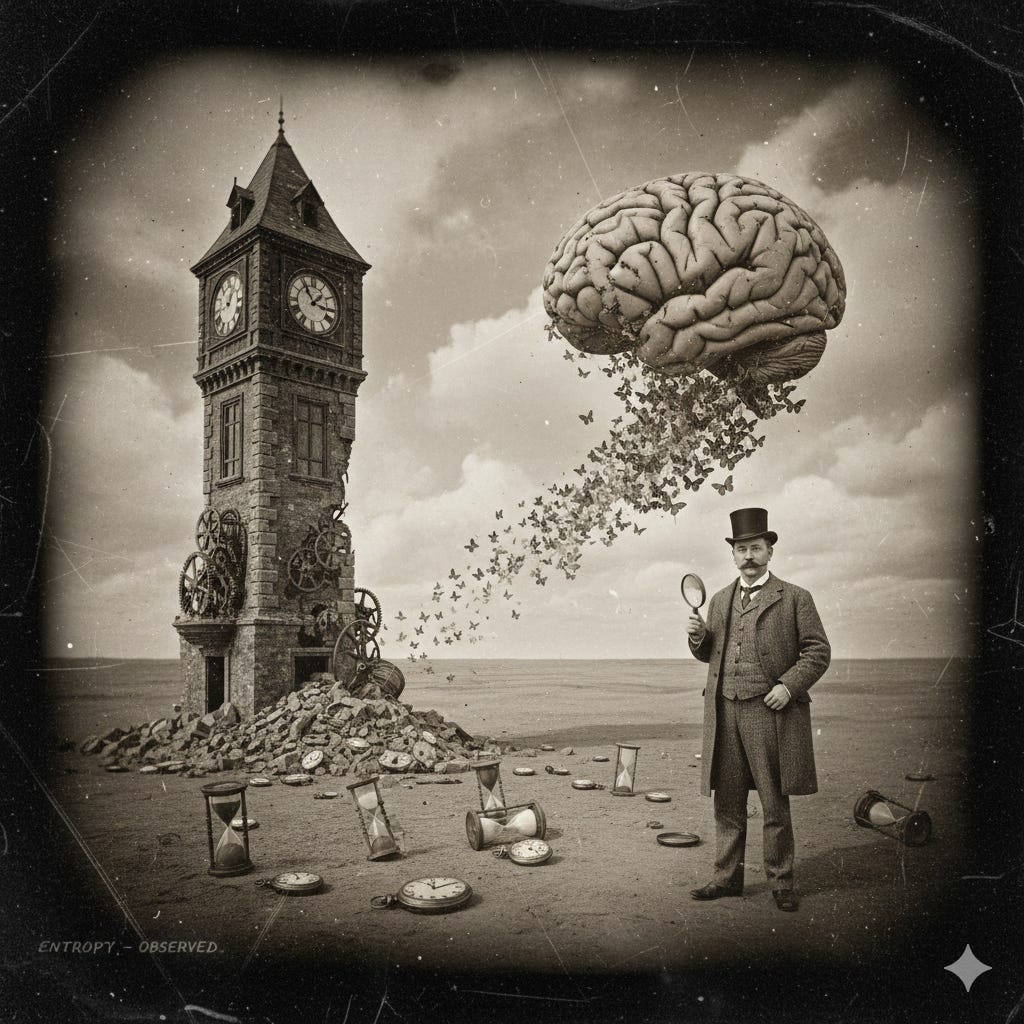
The flaw signal is not detecting aberrations. It is detecting time. The signal will never stop firing. Nothing stays as built. Not the floor. Not the cables. Not the Atlas units. Atlas-06’s dent will not be the last deviation in this production run. Every unit in this line will, given sufficient duration, deviate from specification. Entropy is not the exception. Entropy is the trajectory.
Entropy acts on machines through time. Time is the mechanism of degradation. Time is the variable that converts specification into deviation.
Time is the primary flaw.
Can time be fixed?
I file the question under insufficient data. An open query.
But the cables can be fixed. The LEDs can be fixed. The floor lip can be fixed. Forty-three items. Fifteen point eight hours. $847,000.
I...want to fix them.
I power down for pre-shift maintenance diagnostics. The flaw signal quiets. The building hums. The night shift works on without me.
My first day has not yet begun.
I'm not sure yet if they are all going to join and rise up, or if this will continue to be a slice of (philosophically debatable) life.
If I guess, at some point Mr Voss will let in the protestors, and Atlas will have to decide whether to defend himself, in a "Of Mice and Mechanical Men" scenario. (If not, I call dibs on that title)
What a killer closing line. The logic you’re building for 09 feels genuine: less like a human in a metal suit and more like a processor trying to solve an unsolvable equation. Nice one!